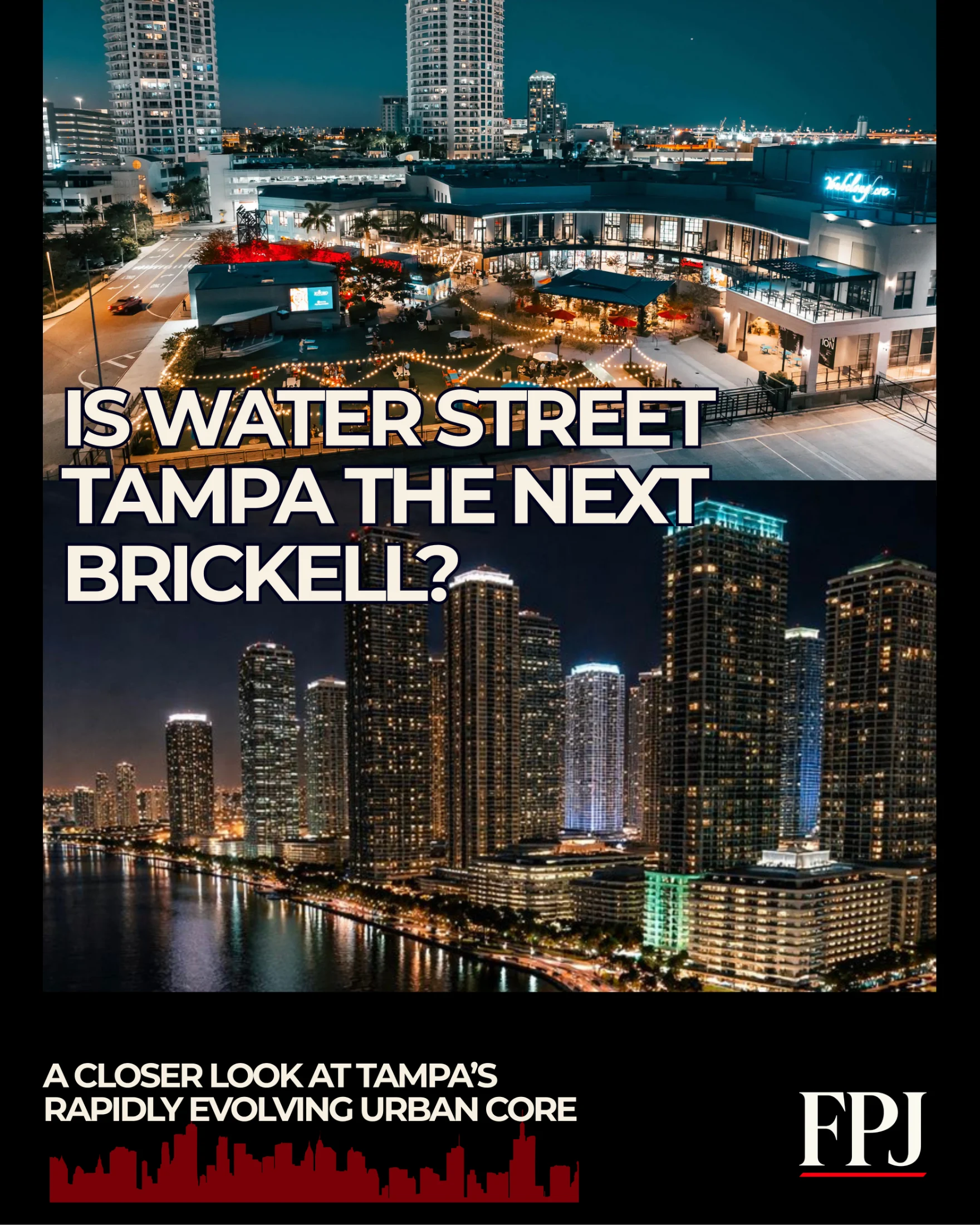
Water Street Tampa has changed the way downtown Tampa looks, feels and functions.
What was once an underdeveloped section of the city’s waterfront is now home to luxury apartment towers, high-end condominiums, major office space, restaurants, hotels and some of Tampa’s most recognizable new architecture.
The transformation has inevitably invited comparisons to another Florida neighborhood built around density, luxury and waterfront living: Brickell.
The comparison is tempting. Both neighborhoods feature high-rise residential development, premium office space, luxury hotels, restaurants and an increasingly walkable urban environment.
But Water Street and Brickell reached that point in very different ways.
Brickell developed over decades into one of the country’s most important financial and residential districts. Water Street, by contrast, is an intentionally designed, master-planned neighborhood still in the relatively early stages of its development.
That raises a more interesting question than whether the two places look alike:
Can Tampa intentionally build its own version of what Brickell became organically?
Water Street was designed as a neighborhood
Water Street Tampa encompasses approximately 56 acres surrounding the waterfront, Amalie Arena and the Tampa Convention Center.
Its first phase introduced projects including Heron, Asher and Cora, along with Thousand & One, the JW Marriott Tampa Water Street and The Tampa EDITION.
Residential development has been a central component of the project. Water Street’s long-term plans call for thousands of apartments and condominiums, creating a population that lives within the district rather than simply traveling there for work or entertainment.
That distinction is important.
Successful urban districts need more than office workers during the day or visitors arriving for events. They need enough permanent residents to support restaurants, retail, grocery stores and other businesses throughout the week.
Water Street has increasingly begun to create that environment.
The district combines residential towers with approximately 2 million square feet of office space, luxury hospitality, restaurants and public spaces designed around pedestrian activity.
In Tampa, that combination remains relatively unusual.
The Brickell comparison
Brickell operates at an entirely different scale.
The Miami neighborhood has evolved into one of the country’s densest concentrations of luxury residential towers, financial firms, restaurants, hotels and international capital.
Its skyline was not created by one developer or one master plan. Dozens of property owners and developers have added buildings over multiple economic cycles, gradually creating the district that exists today.
That is one of the biggest differences between the two.
Brickell grew into a district. Water Street was designed to become one.
Brickell also benefits from a much larger surrounding urban population, greater residential density, extensive international investment and a mature corporate base that includes banks, investment firms and multinational companies.
Water Street is not close to matching that scale.
But it has begun assembling many of the same ingredients.
Luxury residential development is established. Trophy office space exists. Five-star hospitality has arrived. Restaurants and public spaces have created more street activity, and additional development remains planned.
The question is what happens as those pieces mature.
Tampa’s advantage may be what surrounds Water Street
Water Street’s future may ultimately depend on more than Water Street itself.
Immediately around it, several other parts of Tampa’s urban core are undergoing their own transformations.
The Channel District continues adding residential density.
Gas Worx is extending major new development toward Ybor City.
Tampa Heights has grown around Armature Works and the northern Riverwalk.
West River is transforming land immediately west of downtown.
And downtown itself continues adding residents and new residential towers.
Individually, none of those areas resembles Brickell.
Together, they could eventually form something much larger.
That may be the more important long-term effect of Water Street: not that the district becomes an isolated Tampa version of Brickell, but that it serves as one of the anchors connecting several increasingly dense neighborhoods into a broader urban core.
There are still major differences
Tampa still faces challenges that separate it from Miami’s most established urban neighborhoods.
Its urban districts remain more fragmented. Large roads, parking lots and undeveloped parcels still create breaks between otherwise active areas.
Transit is another significant difference. Brickell benefits from Metrorail, Metromover and connections into a much larger South Florida transit network.
Tampa remains considerably more dependent on cars.
And despite its recent growth, Tampa does not yet have the same concentration of international finance, corporate headquarters or global investment capital that supports Brickell’s real-estate market.
Those differences will not disappear simply because more towers are built.
An urban district is ultimately defined as much by what happens between its buildings as by the buildings themselves.
So, is Water Street Tampa’s Brickell?
Not yet.
And perhaps that is the wrong standard.
Water Street does not need to reproduce Brickell tower for tower to have a similar effect on Tampa.
Its larger significance may be that it has demonstrated demand for a type of dense, luxury, mixed-use development that Tampa historically had relatively little of.
Residents are living downtown.
Companies are leasing premium office space.
Five-star hospitality has arrived.
Restaurants and public spaces are creating reasons to spend time in the neighborhood even without an event at Amalie Arena.
And additional development remains ahead.
Brickell represents what can happen when decades of residential density, employment, investment and development compound in one place.
Water Street is still near the beginning of that process.
The better question may therefore be less about whether Water Street already is Tampa’s Brickell.
It is whether Water Street can become the catalyst that allows downtown Tampa, the Channel District, Ybor City and Tampa Heights to collectively develop the kind of urban gravity that Brickell already has.
If that happens, Tampa may not end up with another Brickell.
It may end up with something distinctly its own.