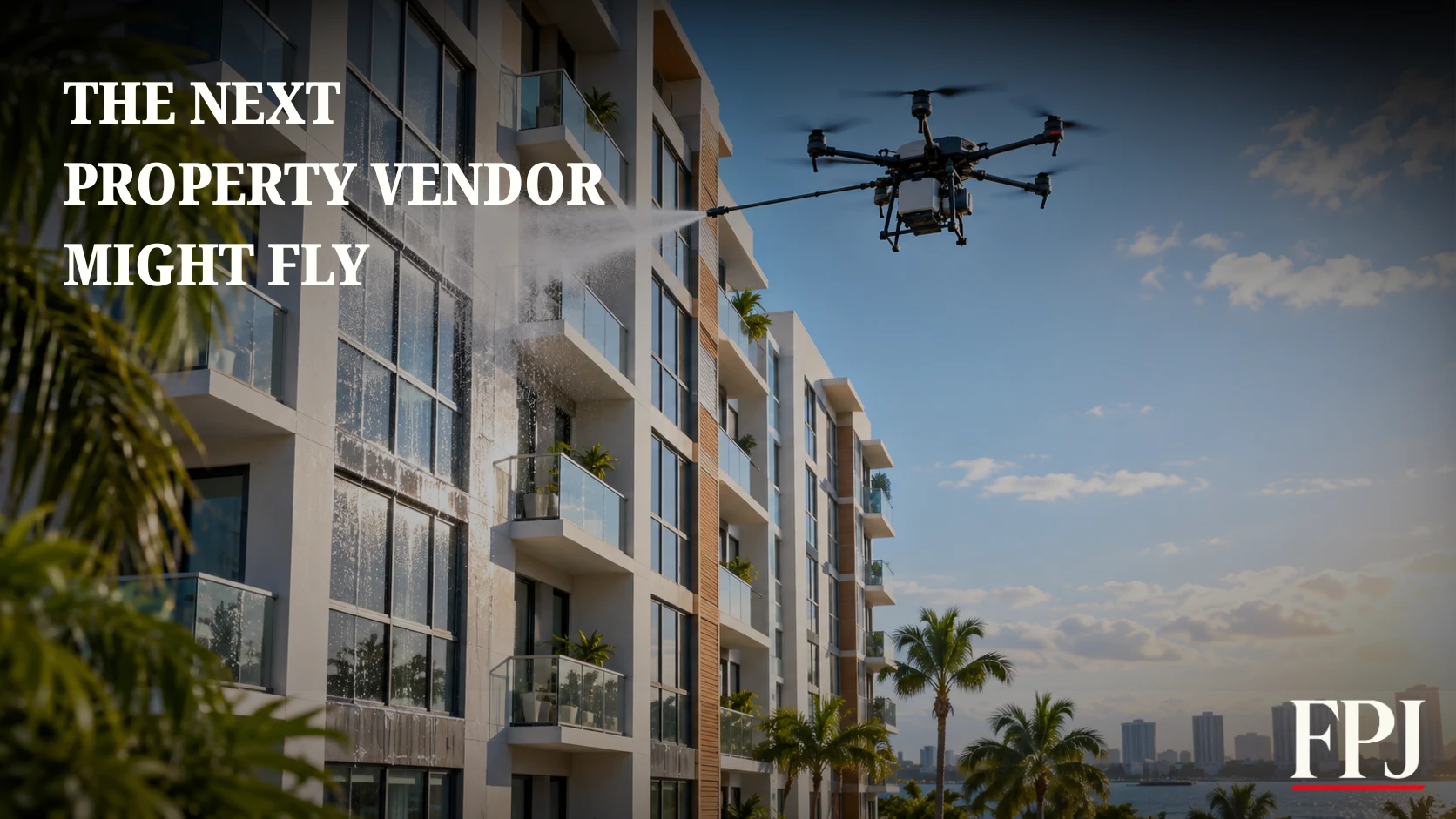
For decades, cleaning the exterior of a multi-story building has required some combination of ladders, boom lifts, scaffolding, ropes and workers operating high above the ground.
A growing group of contractors is beginning to approach the same job differently.
They are sending up drones.
Purpose-built cleaning drones can now pressure wash, soft wash and clean exterior windows while much of the crew remains on the ground. The technology is still relatively new, but adoption has expanded far enough that some property managers are beginning to specifically request drone-based cleaning when work goes out to bid.
For multifamily operators, the potential impact extends beyond having a new piece of equipment on-site. Drones could change how certain exterior-maintenance contracts are staffed, priced and completed.
Charlotte-based robotics company Lucid Bots has become one of the companies driving that transition.
From camera drones to building maintenance
Founded in 2018, Lucid Bots manufactures the Sherpa, a commercial cleaning drone designed for exterior building maintenance.
The system can be configured for window cleaning, soft washing and pressure washing, allowing contractors to clean surfaces such as glass, stucco, EIFS, brick and concrete without positioning a worker directly against the building.
Lucid says more than 400 commercial cleaning operators across more than 40 states now use its technology. The company raised a $20 million Series B earlier this year, bringing total funding to $34 million as it expands manufacturing and its broader robotics platform.
But the strongest use case is not necessarily the tallest building.
Lucid founder and CEO Andrew Ashur told Florida Property Journal that some of the most compelling economics can be found in the type of mid-rise properties common throughout multifamily.
“Wherever you’re going to have the hardest and most difficult headaches to clean traditionally, that’s where the Sherpa is going to give you the best ROI.”
Ashur pointed to a six- or eight-story apartment community stretching several hundred feet horizontally as an especially attractive example.
Traditional crews may need to repeatedly reposition an aerial lift or descend from the roof and move to another section of the building. In some cases, Ashur said crews can spend more time setting up access than actually cleaning.
A drone changes that equation because it can move both vertically and laterally without repeatedly relocating heavy access equipment.
Lucid currently markets Sherpa for exterior cleaning up to roughly 150 feet, making mid-rise buildings a more natural target than skyscrapers.
Where the savings come from
The economic case, according to Ashur, generally falls into three categories: labor, equipment and insurance-related costs.
The first is time.
Ashur said Lucid customers typically expect to complete drone-assisted jobs at least twice as efficiently as traditional methods, with some jobs reaching substantially larger improvements.
“A bad day for them is if they’re not at least twice as efficient.”
He said Lucid has seen certain projects completed as much as eight times faster, although results vary significantly depending on the building and cleaning method.
Less time on-site can translate into fewer labor hours.
The second category is access equipment. Ashur pointed to large boom lifts as an example, noting that renting a 120-foot lift for an extended project can cost more than $10,000 per month.
Avoiding that equipment while also shortening the job can allow the savings to compound.
The third consideration is risk.
Cleaning workers operating on lifts, ropes or other elevated systems create a fundamentally different risk profile than employees working from the ground. Sherpa still requires an operator — this is not a completely autonomous replacement for a cleaning crew — but the worker does not need to occupy the same elevated position as the drone.
For Ashur, that distinction is central to Lucid’s pitch.
“We’re not replacing people. We’re really enabling and empowering them to do more work and do it more safely.”
Property managers are starting to ask for drones
Perhaps the strongest indication that the technology is moving beyond novelty is coming from the buyers themselves.
Ashur said that over roughly the past year and a half, Lucid has increasingly seen requests for proposals that specifically call for drone cleaning, rather than simply asking contractors to submit a general exterior-cleaning bid.
That suggests at least some owners and property managers are becoming familiar enough with the technology to request it directly.
Cost is only part of the reason.
Exterior work can create considerable disruption at an occupied apartment community. Lifts may take up parking spaces or drive aisles, equipment can remain around the property for days or weeks, and contractors need to coordinate their work around residents and building access.
Completing the same scope in less time can reduce that disruption.
Ashur said property managers ultimately want clean buildings that remain attractive to residents, while spending as little time and money as necessary on the process itself.
For multifamily, that creates an interesting proposition: if exterior maintenance can be completed faster and with less equipment occupying the property, owners can potentially reduce both cost and inconvenience to residents.
Florida is already becoming a meaningful market
The technology is not theoretical in Florida.
During his interview with Florida Property Journal, Ashur reviewed Lucid’s customer map and estimated the company now has close to 50 operators in Florida.
That figure was an approximate count rather than a formal company total, but it provides a sense of how quickly the network has spread across the state.
“We have dozens of customers in Florida at this point, and they’re cleaning pretty much every structure you can imagine.”
Lucid itself does not perform the cleaning work. Its model is to provide the technology, software, training and support infrastructure to cleaning companies that then sell and perform the services locally.
That distinction could prove important for the broader property-services industry.
Rather than Lucid replacing existing contractors, its technology can give those contractors another method of performing work — while also lowering the barrier for a new generation of operators to build businesses around robotic cleaning.
Florida presents some particularly relevant conditions.
Ashur noted the state’s humidity and the resulting buildup of algae and mold on exterior surfaces. Those conditions create recurring demand for soft washing in addition to conventional window cleaning.
The Sherpa is also liquid-agnostic, meaning contractors can use their own compatible cleaning products rather than being limited exclusively to a Lucid-branded chemical.
What drone cleaning looks like on the ground in Southwest Florida
For Nick Burgess, founder of Summit Drone Solutions, drone cleaning was not an add-on to an established pressure-washing business.
It was the reason the company existed in the first place.
Burgess told Florida Property Journal that he entered the exterior-cleaning industry without a traditional pressure-washing background after seeing drone technology used for facade and window cleaning several years ago. Summit recently marked its third year in business and now serves Southwest Florida, with Burgess estimating that roughly 60% to 70% of its work is commercial. On the residential side, the company increasingly focuses on community-scale projects or larger homes where the size of the property makes drone deployment more practical.
“The drone really, at the end of the day, is a tool in the toolbox,” Burgess said. “It’s not going to be for every single project.”
For multifamily and commercial properties, Summit generally sells the same three advantages Lucid emphasizes: safety, efficiency and, in some cases, lower cost.
But Burgess added an important Florida-specific qualification.
Southwest Florida’s exterior-cleaning market is highly competitive, meaning drone cleaning does not automatically produce a dramatically cheaper bid on every project. In many cases, Summit’s pricing can be relatively close to conventional cleaning competitors.
When that happens, Burgess said the value proposition shifts toward reducing disruption and completing the work more efficiently.
Traditional access equipment can require roadways, entrances or sections of a property to be blocked while crews reposition lifts or other equipment. A drone can often reduce the amount of time those areas are affected.
That distinction matters for occupied apartment communities, hotels and commercial properties where exterior maintenance has to happen without unnecessarily interfering with the people using the building.
Florida also gives operators something many northern markets do not: a year-round cleaning season.
That creates opportunities for recurring maintenance contracts, although Burgess said it also contributes to aggressive competition among cleaning companies. Florida’s humidity creates another recurring source of demand, as commercial and residential properties continually deal with mold, mildew and other organic buildup on exterior surfaces.
Drones still have limits
Cleaning drones are not about to make every traditional exterior-maintenance method obsolete.
Height remains one of the clearest limitations.
Ashur said the Sherpa’s strongest applications today are generally on mid-rise and lower high-rise buildings, typically under 20 stories. Burgess, speaking from the operator side, said Summit’s preferred range is even narrower.
“Our sweet spot that I like to see is between eight and 10 stories,” Burgess said.
At those heights, he said the company can maintain useful flight time while still completing a meaningful amount of work.
Battery life has historically been one of the practical limitations.
Without Lucid’s new ground-powered tether, Burgess said Summit may get roughly 15 minutes of flight time while working around eight to 10 stories. The company typically brings 14 to 16 batteries and two quick chargers to larger jobs, cycling batteries continuously to keep the drone operating.
Summit has already placed a deposit on Lucid’s Power Tether, which is designed to supply continuous electricity from the ground and reduce the need for those battery swaps.
Height is not the only consideration.
Burgess said evaluating whether a property is suitable for drone cleaning begins with the condition of the building and the surrounding site.
Windows that have been heavily neglected may require manual scrubbing or restoration before they can return to a normal maintenance schedule. Trees positioned close to a facade, neighboring buildings and other physical obstacles can also restrict where a drone can safely operate.
“Managing expectations is such a big part of our business,” Burgess said.
In those situations, Summit may combine drone cleaning with more traditional methods rather than forcing the technology into a job where it does not fit.
That reinforces one of the most important points emerging from both interviews:
The drone is not necessarily replacing exterior cleaning. It is changing how crews access the surfaces that need to be cleaned.
For properties where access is the most difficult, expensive or disruptive part of the job, that distinction can materially change how the work is performed.
The next property-services workforce may look different
One of the more unexpected effects of the technology may involve labor itself.
Ashur said traditional cleaning contractors have generally viewed Sherpa less as a threat to their jobs and more as another tool that expands what crews can safely and efficiently accomplish.
A window cleaner who once spent much of the workday operating from ropes or lifts can increasingly become a drone operator or robotics technician. Ashur said that shift can also help with recruiting and retention in an industry where physically demanding work has historically made staffing difficult.
Summit Drone Solutions offers another example of how that transition may play out.
Burgess originally built Summit specifically around drone cleaning, but customers eventually pushed the company toward a broader exterior-cleaning model. Property owners did not necessarily want one contractor for the drone-accessible portions of a building and another for everything else, so Summit added more conventional services and developed into a more complete exterior-cleaning provider.
That evolution suggests robotics may not replace traditional property-service companies so much as change what those companies look like.
The future operator may use a drone for the portions of a building where access is difficult, conventional equipment where direct contact is necessary, and eventually ground-based robotics for other parts of the job.
Burgess believes greater automation will continue pushing the industry in that direction.
For property-service companies, that could mean a workforce that increasingly combines traditional trade skills with drone operation, robotics and technology management.
The jobs will remain.
The tools — and the skills required to use them — may look very different.
From frontier technology to normal equipment
Lucid is already preparing for the next stage of that transition.
The company recently introduced its Power Tether, which supplies continuous electricity to the Sherpa from the ground and reduces the need for repeated battery changes during longer jobs. Lucid says the system has been tested through more than eight hours of continuous flight.
For operators such as Summit Drone Solutions, that addresses one of the technology’s most practical limitations.
Burgess said Summit currently brings as many as 14 to 16 batteries and two quick chargers to larger projects, continuously rotating batteries as the drone works. At the eight- to 10-story range, he said flight time can fall to roughly 15 minutes before another battery change is required.
Summit has already placed a deposit on a Power Tether, which Burgess described as a potential “game changer” for longer-duration work, particularly on taller buildings.
That evolution illustrates how quickly the technology is moving from proof of concept toward ordinary operating equipment.
Ashur believes the direction is relatively straightforward.
“Robotic-based methods to maintain the building will become the norm versus the frontier application.”
His argument is not that today’s technology can already perform every property-maintenance task. Rather, it is that systems already capable of doing useful work today are likely to become substantially more capable over the next several years.
Burgess has watched that transition begin from the operator side.
When Summit began marketing drone cleaning three years ago, he said property managers and HOA representatives often struggled to understand the concept.
“They looked at me like it was from another planet,” Burgess said. “They couldn’t wrap their head around, ‘You’re going to clean with a drone?’”
Today, he said that reaction is increasingly rare. Even customers who have never hired a drone-cleaning company have often heard of the technology, and more local operators have begun adding drones to their own businesses.
For property owners and managers, that could gradually change how exterior-maintenance bids are evaluated. Price and scope will remain important, but so will the method used to complete the work, the amount of equipment required on-site, the disruption created for residents or tenants and the number of workers who need to operate at height.
Florida property professionals can see it in person
Lucid is scheduled to hold a hands-on Sherpa demonstration in Miami on October 21, giving property owners, managers and service contractors an opportunity to see the technology operate in person.
Ashur encouraged Florida property professionals interested in drone cleaning to attend or connect with Lucid, which can refer owners and managers to operators serving their respective markets.
That matters because both Ashur and Burgess described essentially the same challenge: drone cleaning can be difficult to fully appreciate until someone sees it working on an actual building.
For an industry that has relied on lifts, scaffolding, ropes and other high-access methods for decades, adoption is unlikely to happen everywhere at once.
Traditional cleaning methods will remain necessary for extremely tall buildings, restoration work, difficult sites and surfaces that require direct physical contact. Drone cleaning is not eliminating those methods.
But it is beginning to create another option.
For the right property, that can mean less equipment on-site, fewer workers operating at height, shorter project timelines and a different approach to how exterior maintenance is planned.
Three years ago, Burgess said he often had to convince customers that cleaning a building with a drone was even possible.
Today, nearly 50 Lucid operators are estimated to be active across Florida, property managers are beginning to encounter drone-specific requests and bids, and new operators continue entering the market.
The technology is still early.
But the question is beginning to change from whether drones can clean buildings to where they make the most sense to use.
And if Ashur’s prediction is right, five years from now the unusual part may not be seeing a drone clean an apartment building.
It may be seeing one cleaned without one.