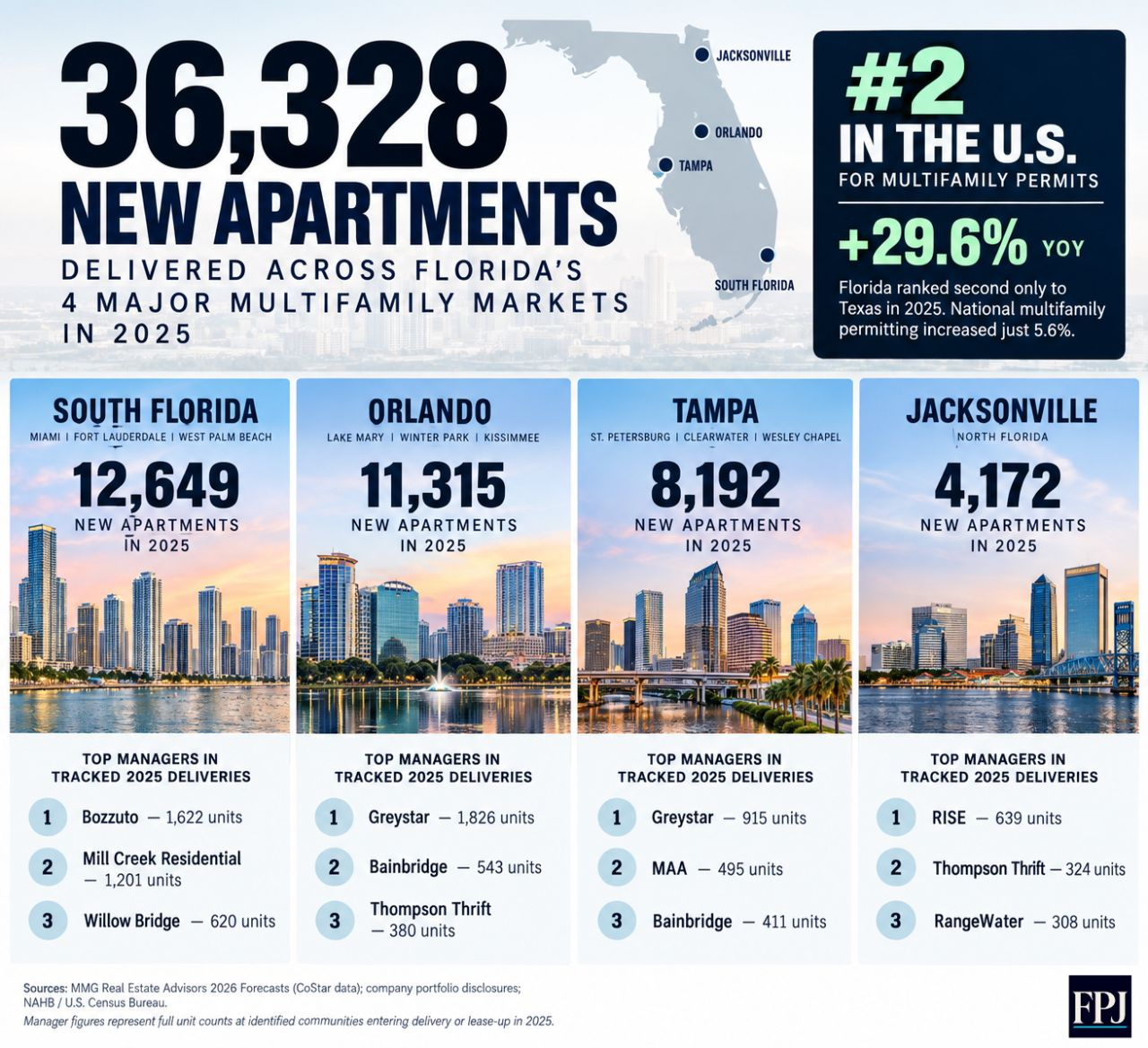
Across South Florida, Orlando, Tampa and Jacksonville, developers completed a combined 36,328 apartment units in 2025, according to MMG Real Estate Advisors’ market forecasts, which cite CoStar data.
South Florida accounted for the largest share of the four-market total:
South Florida: 12,649 units
Orlando: 11,315 units
Tampa: 8,192 units
Jacksonville: 4,172 units
The figures capture the scale of new supply across these four markets. They do not represent Florida’s statewide apartment completion total.
Florida ranked second nationally for multifamily permitting
Florida also ranked second in the United States for multifamily permitting in 2025, trailing only Texas.
Permitting activity in the state increased 29.6% from 2024, compared with a national increase of 5.6%, according to the National Association of Home Builders, using U.S. Census Bureau data.
Permits indicate potential future construction, rather than apartments already underway or guaranteed to be delivered. Even so, the increase adds another dimension to Florida’s supply story: substantial recent completions alongside continued permitting activity.
Florida Property Journal also examined the operators associated with a selection of communities entering delivery or lease-up during 2025. The findings below reflect current management information for those identified communities, rather than comprehensive market-wide rankings.
South Florida led the four markets examined
South Florida recorded 12,649 apartment completions in 2025, the largest total among the four markets reviewed.
Among the communities identified by FJP, Bozzuto has the largest tracked management footprint, at approximately 1,622 units across Wynwood Plaza Residences, Aura North Miami Beach, Affina, Amara Wynwood and Avara.
Mill Creek Residential accounts for approximately 1,201 units across Modera Riverside, Modera Aventura and Modera Coral Springs Phase II. Mill Creek operates as a vertically integrated developer and owner-operator.
Willow Bridge Property Company accounts for another 620 identified units through PIXL Plantation and Arvella Aventura.
These figures reflect the full unit counts of the identified communities, with the limitations explained in the methodology below.
Greystar has a substantial footprint in Orlando’s delivery group
Orlando completed 11,315 apartments in 2025, exceeding its 10-year average annual completion pace of 9,011 units.
Among the communities reviewed by FJP, Greystar accounts for approximately 1,826 units across Northhaven, Abrazo at Four Corners, Alta Trilogy, Yardly Mount Dora, V by Alta and Futura at Nona Cove.
Bainbridge accounts for another 543 units across Bainbridge Sand Lake and the 176-unit second phase of Bainbridge Mission Pointe.
Thompson Thrift’s Junction at Rockledge adds 380 units to the tracked group.
Tampa added more than 8,000 apartments
Tampa’s multifamily market completed 8,192 units in 2025.
Greystar has the largest identified footprint in FJP’s tracked Tampa group, with approximately 915 units across Upshore, SkyMor Wesley Chapel, Altera Conner Park and SkyMor Southshore Bay.
Other substantial communities reviewed include the 495-unit MAA Breakwater and 411-unit Bainbridge Wesley Chapel.
For the teams operating these communities, delivery marks the beginning of the work required to attract residents, manage maintenance and establish day-to-day operations.
Jacksonville delivered another 4,172 units
Jacksonville recorded 4,172 apartment completions in 2025, the smallest total among the four markets examined.
RISE has the largest identified management footprint in FJP’s tracked Jacksonville group, totaling 639 units across RISE Baymeadows and RISE at Glen Kernan Park. RISE identifies development, construction and property management among its services for these projects.
Thompson Thrift’s Terrassa accounts for 324 units, while the 308-unit Palmhouse Jacksonville is operated by RangeWater Real Estate.
After delivery comes the operating challenge
More than 36,000 new apartments entered these four Florida markets in a single year.
Each community requires leasing teams, maintenance operations, vendors, marketing and resident services as it moves toward stabilization.
That makes this wave of apartment deliveries a significant property-management story. Construction creates the inventory; operating teams take on the work of leasing and running it.
The next question is how quickly renters absorb that new supply—and how effectively operators manage the transition from delivery to stabilized occupancy.
With Florida finishing 2025 second nationally for multifamily permitting, another question is worth watching: could the state surpass Texas in 2026?
Methodology and sources
Florida Property Journal reviewed 2025 multifamily completion data from MMG Real Estate Advisors’ 2026 Florida market forecasts, which cite CoStar as the underlying source. The combined 36,328-unit figure covers South Florida, Orlando, Tampa and Jacksonville, rather than the entire state.
State and national permitting figures come from the National Association of Home Builders, using U.S. Census Bureau data.
Management-company figures were compiled separately by matching identified 2025 delivery and lease-up communities with current company portfolio information and operator disclosures. Current management does not necessarily establish who managed a property at the time of delivery.
Management totals represent the full unit counts of identified communities or specified phases entering delivery or lease-up during 2025. They are not an audited allocation of the exact number of units physically completed by each manager during the calendar year.
This distinction is particularly relevant for phased projects, where portions of a community may deliver across multiple reporting periods. The tracked sample is not exhaustive, and company comparisons apply only to the communities reviewed by FJP.