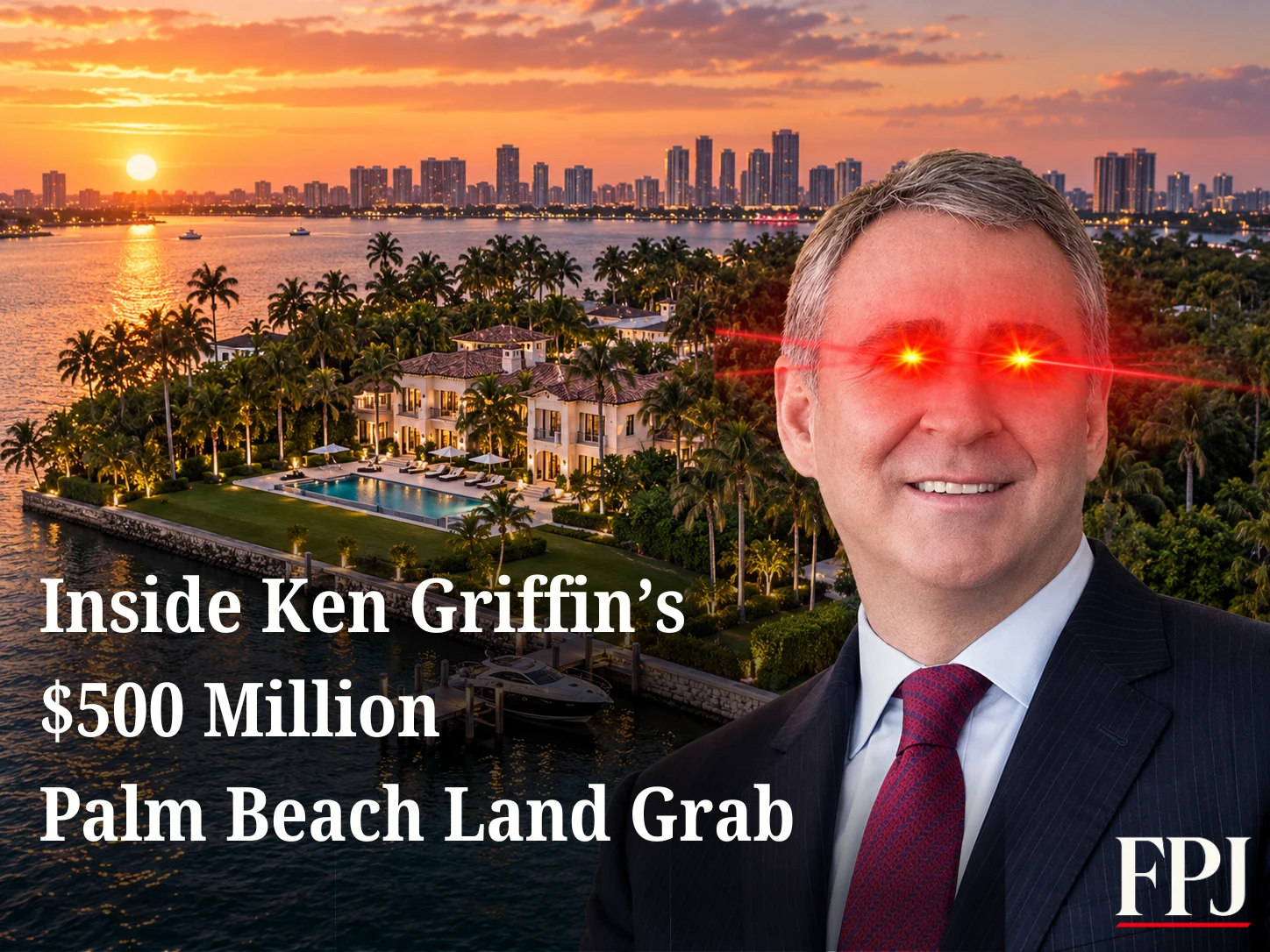
Most people who spend $100 million on a mansion probably intend to keep the mansion.
Ken Griffin had a different idea.
Beginning in 2012, Griffin started acquiring neighboring properties along Palm Beach’s South End, on the stretch of South Ocean Boulevard commonly known as Billionaires’ Row.
The purchases included oceanfront mansions, vacant lots and eventually property extending from the Atlantic Ocean to the Intracoastal Waterway.
Many of the homes were worth tens of millions of dollars.
Several were demolished.
Because Griffin wasn’t really assembling houses.
He was assembling land.
More than a decade later, companies tied to Griffin control more than 27 contiguous acres in Palm Beach, creating what has been described as the largest residential assemblage on the island.
The estimated cost of putting it together?
More than $500 million.
And after years of buying, demolishing and redesigning, Griffin is finally building.
Who Is Ken Griffin?
To understand how someone gets into a position to spend half a billion dollars assembling Palm Beach real estate, it helps to understand who Ken Griffin is.
Griffin is the founder and CEO of Citadel, the global investment firm he founded in 1990 after first beginning to trade while attending Harvard.
He later helped establish Citadel Securities, which has grown into one of the world’s largest market makers.
The two businesses have made Griffin one of the wealthiest people in the world.
As of September 2026, Forbes estimated his net worth at approximately $53.5 billion, placing him among the world’s 40 richest people. That figure is near the highest public estimates of Griffin’s fortune to date.
That wealth has also made Griffin one of the world’s most aggressive buyers of trophy real estate.
His holdings have included record-setting properties in New York, Miami, London, Aspen and elsewhere.
But even among that portfolio, Palm Beach stands apart.
Griffin didn’t simply buy an estate.
He built one out of an entire collection of them.
It Started With Four Properties
The strategy began just before the end of 2012.
Companies tied to Griffin acquired four adjacent oceanfront properties at 20, 30, 40 and 50 Blossom Way for a combined total of roughly $129.6 million.
Together, the four properties gave him approximately eight acres and hundreds of feet of beachfront.
At the time, the combined purchase itself was a Palm Beach record.
It would eventually look like the opening move.
Three years later, Griffin added 70 Blossom Way for approximately $15.2 million.
Then came one of the pieces he apparently needed most.
In January 2017, Griffin paid $85 million for the roughly 4.2-acre estate at 1290 S. Ocean Boulevard, which sat beside his existing properties.
The house itself was nearly 18,000 square feet.
The plan was to tear it down.
By that point, Griffin had spent roughly $215 million assembling five contiguous oceanfront properties.
And he kept going.
Buying the Neighbors
In 2018, Griffin moved to the other side of South Ocean Boulevard.
He acquired his first lakefront property at 1285 S. Ocean Boulevard, beginning to extend his holdings toward the Intracoastal side of the island.
A few months later, he paid $20.25 million for the nearly two-acre estate at 10 Blossom Way.
Then came 2019.
A Griffin-linked company paid $104.99 million for La Follia, the estate of the late Broadway producer and banking heiress Terry Allen Kramer at 1295 S. Ocean Boulevard.
La Follia was hardly a teardown.
The Italian Renaissance-style estate measured approximately 37,500 square feet and sat on roughly 4.5 acres stretching from the ocean to the Intracoastal.
The sale briefly set a Palm Beach residential record.
Griffin bought it anyway.
Then, only months later, another Griffin-controlled entity paid $99.13 million for the beachfront mansion at 60 Blossom Way.
That house measured more than 18,000 square feet and sat on nearly 3.6 acres.
It was later demolished.
Piece by piece, the puzzle was disappearing.
And one much larger property was taking its place.
The Mansions Were Almost Secondary
That may be the most interesting part of Griffin’s strategy.
These weren’t distressed houses purchased because the buildings had no value.
They were trophy estates.
But at the highest end of Palm Beach real estate, the structure sitting on a property may not necessarily be its most important asset.
The land underneath it can be much harder to replace.
Palm Beach is a narrow barrier island with a finite amount of waterfront property. Creating a new 20- or 30-acre oceanfront estate from scratch is effectively impossible unless someone can convince a collection of existing owners to sell.
So Griffin did exactly that.
One property at a time.
Instead of taking a large estate and subdividing it into smaller lots, Griffin effectively did the reverse.
He took individually valuable properties and stitched them back together.
At that level of the market, a $20 million house can become a land acquisition.
An $85 million mansion can become a missing piece.
And a $100 million estate can still end up underneath a bulldozer.
Bigger Than Mar-a-Lago
The final scale becomes easier to understand with a nearby comparison.
Federal historic-property records place Mar-a-Lago at approximately 16.98 acres.
Griffin’s assembled Palm Beach holdings now exceed 27 contiguous acres.
That makes his property roughly 10 acres larger.
His estate has also been reported to include approximately 1,400 feet of contiguous beachfront, or more than a quarter mile along the Atlantic.
Using the reported $500 million-plus acquisition cost, Griffin has effectively spent somewhere around $18 million per acre on a blended basis.
But even that calculation probably misses the point.
Twenty-seven individual acres scattered around Palm Beach are one thing.
Twenty-seven contiguous acres stretching across one of the most exclusive residential markets in the country are something entirely different.
The assembly itself creates scarcity.
Now He’s Building
For years, the story was mostly about what Griffin was buying and tearing down.
Now it is about what comes next.
On roughly eight acres at 60 Blossom Way, construction is underway on an oceanfront residence commissioned by Griffin for his mother, Catherine Gratz Griffin.
Approved plans call for a main residence, separate guesthouse and utility building totaling approximately 44,000 square feet.
The project is being led by Seattle architecture firm Olson Kundig, working with Palm Beach architect of record Smith and Moore Architects and landscape designer Stoev Design Group.
The house for Griffin’s mother is not expected to be the end of the project.
Griffin has also indicated plans for another residence on the property for himself and his family.
What is emerging is less a single mega-mansion than a private family compound built across land accumulated over more than a decade.
What Is It Actually Worth?
That may be the hardest question.
Recent reporting has placed the potential finished value of Griffin’s Palm Beach estate at approximately $1 billion.
That number should be treated as an estimate rather than an appraisal.
There simply aren’t many comparable transactions.
A $100 million Palm Beach mansion can be compared with another $100 million Palm Beach mansion.
A 27-acre contiguous ocean-to-Intracoastal compound assembled over more than a decade is much harder to price.
And Griffin’s broader real-estate history suggests that scarcity is often part of the strategy.
His international property portfolio has been estimated at more than $1.5 billion, including his record-setting $238 million purchase at 220 Central Park South in Manhattan, holdings on Miami’s Star Island and Coconut Grove, and properties in London, Aspen and elsewhere.
Palm Beach may be the clearest example of that philosophy.
He did not wait for a 27-acre estate to come onto the market.
There probably wasn’t one.
So he created it.
One mansion.
One neighbor.
One parcel at a time.
More than $500 million later, the houses Griffin bought may ultimately be the least important part of what he acquired.
The real asset was the dirt underneath them.
And now that the land has finally been assembled, the question is no longer what Ken Griffin paid for it.
It’s what 27 contiguous acres of Palm Beach could possibly be worth today.