Florida’s retail market is not simply growing or shrinking.
It is changing tenants.
Throughout 2026, new stores have continued opening across the state even as several familiar brands close locations, convert stores or reduce their footprints. Discount grocery, value retail and newer fitness concepts are among the categories gaining ground, while legacy grocers, dollar stores and older gym chains account for some of the most visible contraction.
Data compiled by Boca Raton-based Woolbright Development provides a month-by-month look at larger retail-box openings and closings across Florida. Through July, the numbers reveal several clear trends — and a significant amount of real estate changing hands.
Rather than simply rank retailers by raw store count, Florida Property Journal selected three notable expansion stories from different retail categories and three brands that have been pulling back.
Three retailers expanding across Florida
ALDI — grocery
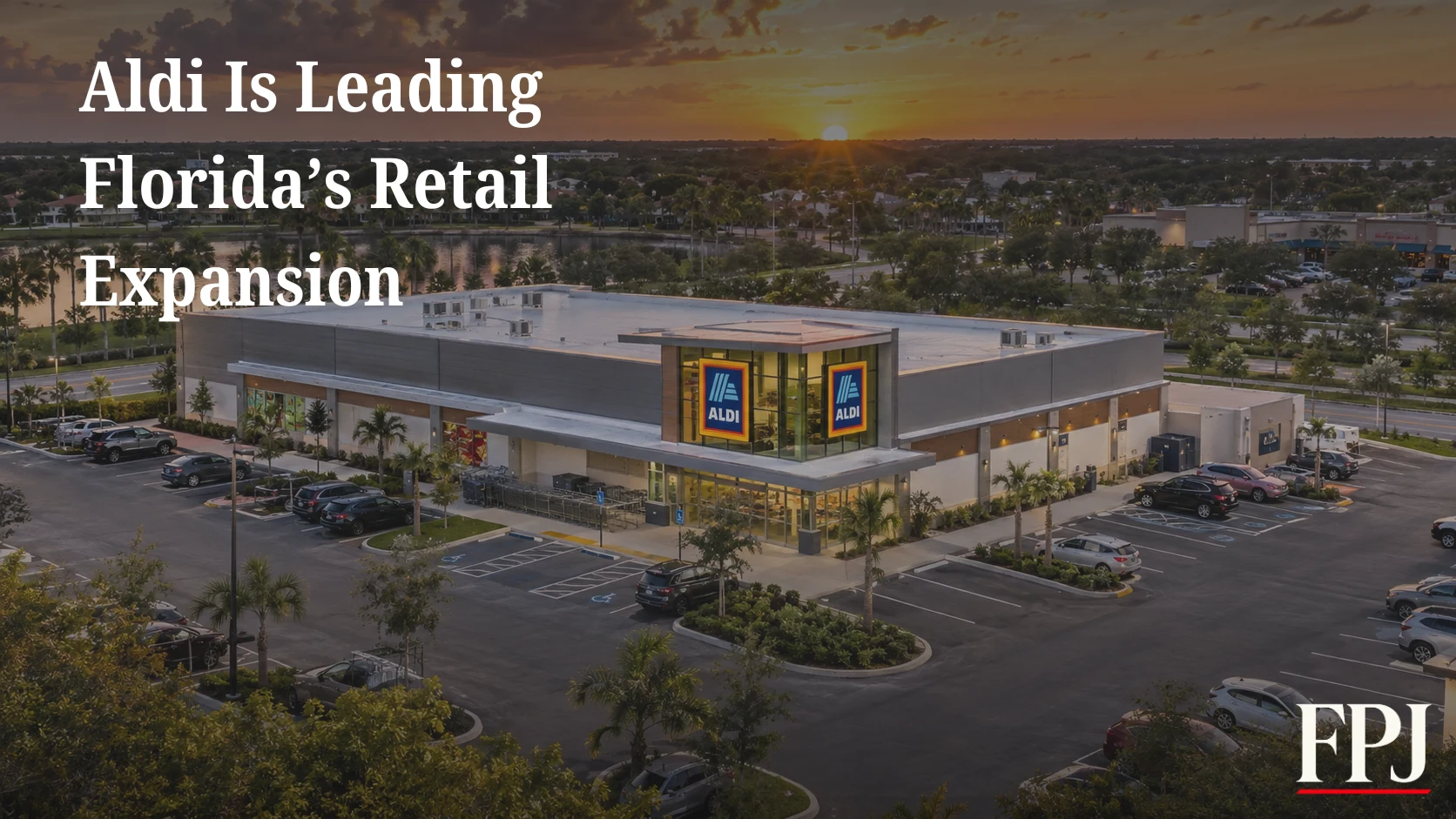
No retailer on the list is expanding in Florida quite like ALDI.
Woolbright tracked 35 ALDI openings and one closing in Florida between January and July, a net increase of 34 locations during the period. A large portion of that expansion is tied to ALDI’s acquisition of Southeastern Grocers and its ongoing conversion of former Winn-Dixie and Harveys stores.
The strategy extends well beyond individual stores.
ALDI plans to convert nearly 80 Southeastern Grocers locations across the Southeast during 2026 and more than 200 by the end of 2027. The company is also expanding its Haines City distribution operation and plans a new distribution center in Baldwin, Florida, projected to open in 2027.
For landlords, the expansion illustrates how quickly a major retailer can reposition an existing box rather than wait for new construction.
Many former Winn-Dixie locations already sit at established neighborhood shopping centers with parking, loading access and surrounding residential density. Converting those spaces allows ALDI to grow faster while preserving grocery use at many of the centers involved.
Five Below — value retail
Five Below represents a different kind of growth story.
The Philadelphia-based value retailer reached its 2,000th U.S. store in July and expects to add approximately 150 net new locations nationwide during fiscal 2026. Through the first half of its fiscal year, the company had already opened 101 net new stores while reporting a 27.5% year-over-year increase in sales.
Florida has been part of that expansion.
Woolbright tracked three Five Below openings in February and another three in July, while one Florida location closed in March. Separate location data now places the chain at roughly 186 stores across Florida.
The company’s continued growth is notable because it occupies the kind of small- to mid-size retail box found throughout Florida’s suburban shopping-center inventory.
Five Below does not need a regional mall or massive freestanding building. Its model fits neighborhood and power centers where landlords are often trying to fill spaces left by other specialty retailers.
That makes its expansion relevant beyond the number of stores alone.
EōS Fitness — fitness
Fitness centers are also becoming increasingly important users of traditional retail space.
EōS Fitness currently lists 38 Florida locations and has additional gyms planned across markets including Bradenton, Oldsmar, St. Petersburg, Brandon, Lutz, Dunedin, Orlando, Palm Beach Gardens and Pinellas Park.
Woolbright tracked four Florida EōS openings in June and July alone, while the company has also been acquiring existing big-box gyms and repositioning them under the EōS brand. In the first quarter of 2026, EōS said it acquired 14 gyms across Florida and three other states as part of its national expansion strategy.
The format is particularly important for commercial real estate because gyms can absorb spaces that are difficult for conventional retailers to reuse.
A recent EōS opening in Fort Myers occupies approximately 40,000 square feet, illustrating the scale these facilities can bring to a shopping center.
As traditional department, furniture and specialty retailers reduce footprints, fitness operators have become one of the categories capable of taking larger boxes and generating regular customer traffic.
Three retailers pulling back
Winn-Dixie — grocery
Winn-Dixie has experienced the largest visible contraction of the six brands, although the numbers require context.
From January through July, Woolbright tracked 58 Winn-Dixie closures and seven openings in Florida, representing a net reduction of 51 stores.
But many of those closures are not traditional retail failures.
They are part of ALDI’s conversion strategy following its acquisition of Southeastern Grocers. Former Winn-Dixie stores across Florida have temporarily closed and are being remodeled into ALDI locations. Recent examples in Miami include stores in Liberty City, Pinewood and Overtown.
Winn-Dixie itself continues operating and has also converted former Harveys Supermarkets into the Winn-Dixie banner this year.
The result is less a straightforward disappearance than a major restructuring of Florida’s grocery landscape.
For shopping-center owners, the signs on the building may change while the grocery anchor itself remains.
Family Dollar — value retail
Family Dollar has been moving in the opposite direction from Five Below.
Woolbright recorded 12 Florida Family Dollar closures through July, including six in February and additional closures in March, April and July.
The pullback comes during a period of broader change for the chain.
Dollar Tree completed the sale of Family Dollar in July 2025, transferring the business to 1959 Holdings. Dollar Tree has since continued operating its namesake chain separately.
Family Dollar’s contraction is notable because its stores are typically smaller than supermarket or gym boxes and often occupy neighborhood shopping centers or freestanding locations.
Those spaces may be easier to refill individually, but a wave of closures can still create noticeable vacancies across local retail corridors.
LA Fitness — fitness
Florida’s fitness market also illustrates how expansion in one brand can occur alongside contraction in another.
Woolbright tracked 10 LA Fitness closures in Florida from January through May, including six closures in March alone.
At the same time, EōS and other value-oriented fitness concepts continue expanding.
That creates an interesting real-estate dynamic. Large gyms require significant square footage, parking and expensive interior buildouts, which can make a vacated fitness box challenging for many conventional retailers.
But another gym operator can often reuse much of the same underlying real estate.
EōS itself said it acquired 14 existing gyms across four states during the first quarter, illustrating how fitness locations can move from one operator to another without leaving the retail category altogether.
The boxes are not necessarily going dark
The most important takeaway may be that a closure does not automatically mean a vacant shopping center.
In several cases, Florida’s shrinking retailers are creating inventory for expanding ones.
A former Winn-Dixie can become an ALDI.
An older gym can become an EōS or another fitness concept.
A vacant specialty-retail box can attract Five Below, Burlington, Ross or another value-oriented tenant.
That turnover matters for landlords because the strongest leasing demand is increasingly coming from retailers with very specific operating models: value, convenience, necessity and experience.
ALDI sells groceries at a low-cost format.
Five Below is built around inexpensive discretionary purchases.
EōS sells a high-value, low-price gym membership that requires customers to physically visit the property.
Different categories, but a similar theme.
All three give consumers a clear reason to keep visiting a physical location.
Florida retail is being reshuffled
The expansion and contraction happening across Florida does not support a simple narrative that brick-and-mortar retail is disappearing.
Instead, the tenant mix is changing.
Some long-established brands are shrinking, while newer or faster-growing concepts are taking their place. In many cases, the same shopping-center real estate is simply being repurposed for a different operator.
For Florida landlords and developers, that shift creates both risk and opportunity.
A departing tenant can leave behind tens of thousands of square feet that must be filled.
But in a state that continues to add residents and consumer demand, there remains a growing list of retailers willing to take those spaces — provided the location, demographics and economics work.
The question for shopping centers increasingly may not be whether another tenant exists.
It is which category will take the box next.